
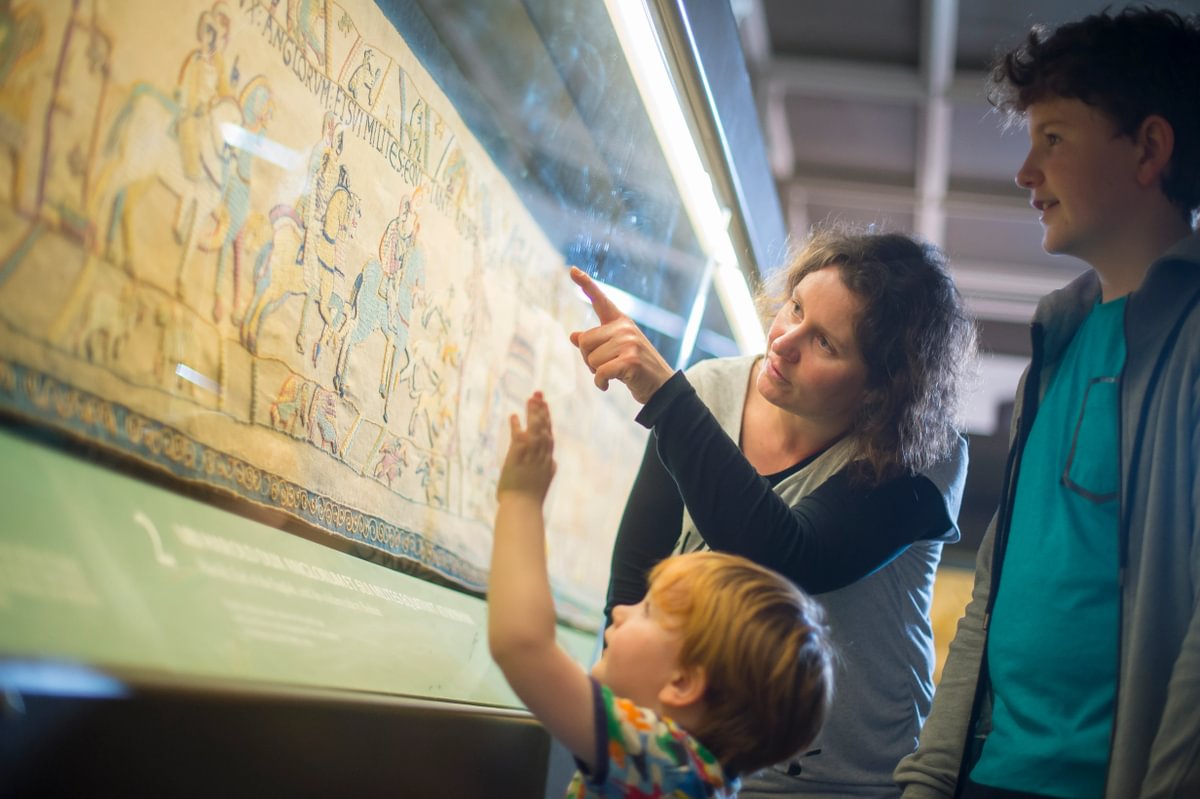
Reading Museum is increasing the availability of its popular public tours as it celebrates the 140th anniversary of the completion of Britain’s Bayeux Tapestry.
This historic work is a full-scale replica of the medieval original. Although it is commonly referred to as a tapestry, the piece is actually an embroidery hand-stitched with woollen yarns onto a linen backcloth.
The project began in 1885 after Elizabeth and Thomas Wardle visited the original tapestry in France and decided that England should have its own copy.
Between 1885 and 1886, 35 women from the Leek Embroidery Society in Staffordshire got stitching.
The Victorian embroiderers based their work on tracings of hand coloured photographs from the Victoria & Albert Museum.
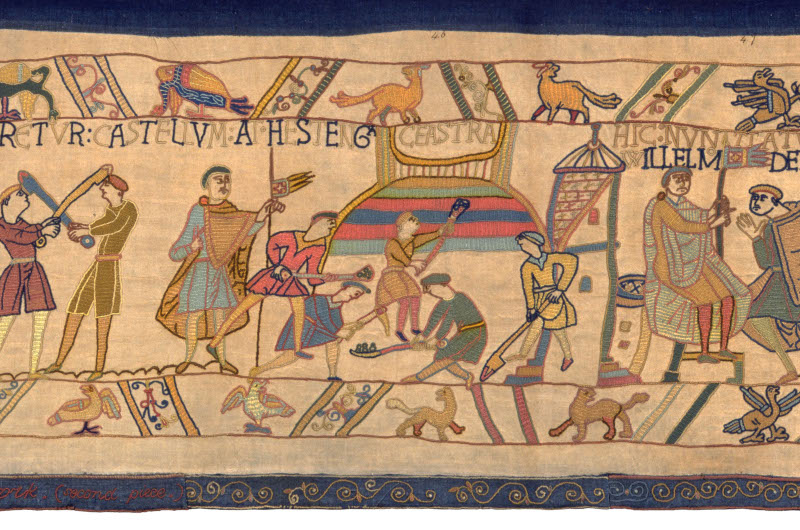
While the replica is 70 metres long, it is slightly taller than the original because it includes an extra blue border where the women stitched their names under the sections they completed.
And it may be a copy, but it’s not an exact copy. While all the main panels are intact, the colours are near identical, and the wording the same, Victorian preferences meant the stitchers created a less vulgar version. One famous variation is the addition of underpants to a figure who is naked in the original, and other coarser details, including more than 90 penises.
They also made additions: at the bottom of each panel is the name of the embroiderer. Although nearly three dozen stitchers worked on the tapestry, they ensured it looked like the tapestry they were recreating, not their own handiwork.
Once the Leek women’s work had been completed, it went on tour. Stops along the way included Germany and America.
The tapestry arrived at Reading Town Hall in June 1895, and was purchased by Alderman Arthur Hill, a former Mayor, who gifted it to the museum where it has remained for over 130 years.
It has been on permanent display since 1993, and to protect it, it is in a specially designed case. When the gallery opened, it was the first time in decades that the entire tapestry could be seen in one gallery.
And it has been added to. In 2019, Jan Messent created a half-size imagining of what the final panel would have looked like. At some stage, the panel was removed and is missing. Before stitching, she researched extensively to create an image of William as King of England on his throne.
This autumn, the original Bayeux Tapestry is due to go on display in the Sainsbury Exhibitions Gallery at the British Museum – the first time it has been exhibited in the UK for a thousand years.
Nicholas Cullinan, Director of the British Museum, said: “The Bayeux Tapestry is one of the most important and unique cultural artefacts in the world, which illustrates the deep ties between Britain and France and has fascinated people across geographies and generations.
“It is hard to overstate the significance of this extraordinary opportunity of displaying it at the British Museum and we are profoundly grateful to everyone involved.”
But for those who can’t wait, or don’t want to travel to London, can visit the Victorian recreation for free, simply by heading to Reading Town Centre.
Staff at Reading Museum encourage people to consider seeing both.
Matthew Williams, Reading Museum Manager, said: “The arrival of the Norman tapestry this autumn and the Year of the Normans celebrations in 2027, provides a unique opportunity to discover two Bayeux Tapestries as well as Reading’s Norman history in Reading Abbey Quarter, all linked by one train line – the Elizabeth Line.”
When is Britain’s Bayeux Tapestry coming to Reading, and how can I get tickets?
Britain’s Bayeux Tapestry is on permanent display at Reading Museum, Blagrave Street, Reading, RG1 1QH.
The museum is situated a two-minute walk from Reading Station.
The galleries are open from Tuesday to Saturday with free entry for all visitors.
Special guided tours of the tapestry led by museum staff are held every Thursday at 2.30pm and every Saturday at 2pm. These guided sessions cost £8 and last around an hour.
For more details, log on to: https://www.readingmuseum.org.uk/collections/britains-bayeux-tapestry
From April, the museum also offers tours of the medieval Abbey Quarter every Saturday. These tours visit the Abbey Ruins, the Hospitium, and the Abbey Gateway, where Jane Austen was once a student.
The Abbey Quarter tours cost £10, although the ruins themselves are open free of charge every day for public access. For more details, log on to: https://www.readingmuseum.org.uk/your-visit/reading-abbey-quarter
Tickets for all guided events can be booked online at www.readingmuseum.org.uk
Get Cheeselogs in your inbox!
Sign up to our weekly newsletter for the latest posts, news and surprises. It's completely free, and goes straight to your inbox.